Bugs and ideas
| Bugs | Ideas | |
|---|---|---|
| Install | specify extension add bug |
specify extension add assess |
| Commands | /speckit.bug.assess, fix, test |
/speckit.assess.intake, research, define, shape, decide |
| Reports land in | .specify/bugs/<slug>/ |
.specify/assessments/<slug>/ |
| Ends in | A verified fix, or closed as invalid | A go, needs-clarification or kill verdict |
Both are Spec Kit’s own extensions, and neither goes through specify, plan and tasks. Where your Spec Kit has bundles, specify bundle install bugfix or specify bundle install assess adds the extension and a guided workflow together.
What the two share
Section titled “What the two share”Each command writes one markdown report into the item’s folder. Name the item once with slug= and reuse the name on every later command.
The sidebar has a Bugs pane and an Ideas pane under Specs. They’re built from the reports on disk, so an item you handled by typing the commands yourself shows up the same. Before an extension is installed, its pane holds one row that installs it. The viewer and sidebar explains the groups.
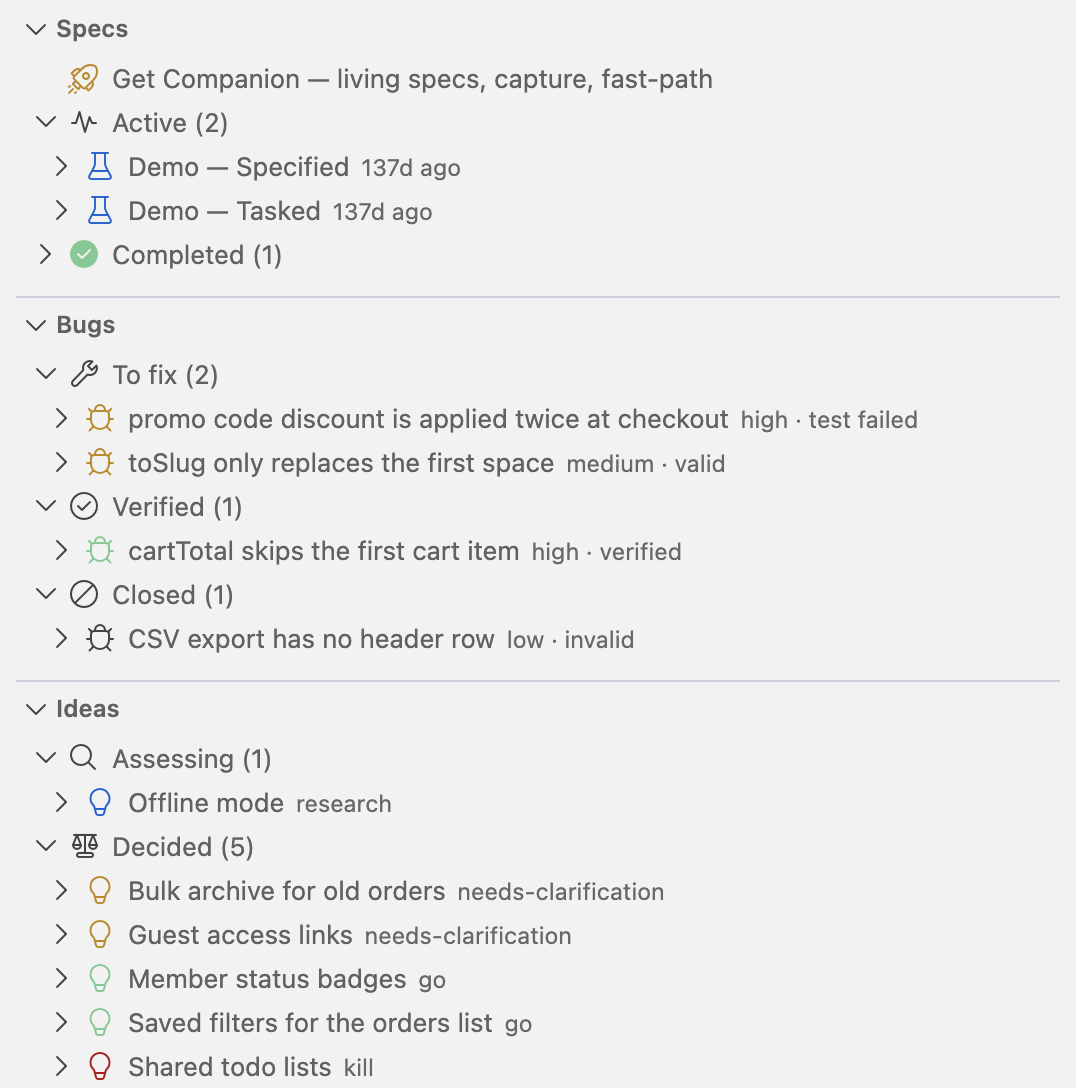
To start one from Companion, choose + on the pane, describe it and press Assess bug or Assess idea. The folder name is suggested from what you wrote and you can edit it. A name that’s already taken can’t be sent.
Click an item and it opens in the viewer with one tab per report. A report that isn’t written yet is disabled. The pages are for reading: there’s no Overview and no comment button, and the viewer writes nothing to the item’s folder. The page updates when a report changes on disk.
The footer holds the next step. A button sends that command to your assistant with the item’s name, and when the report it writes appears, the buttons move on by themselves.
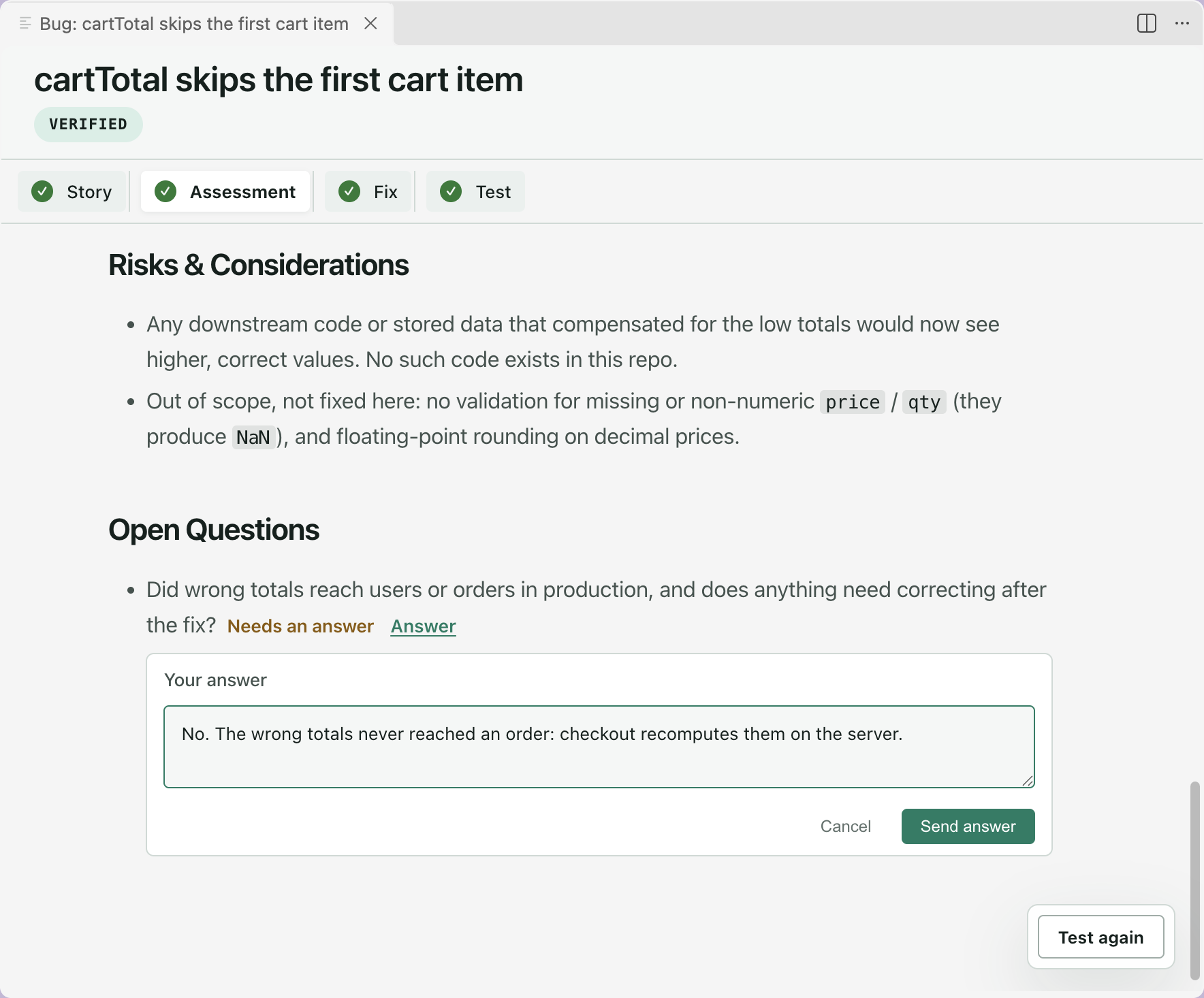
An open question shows Needs an answer with an Answer button, on a bug’s Assessment, Fix and Test tabs and on an idea’s Intake, Research, Problem and Concept tabs. Your reply is saved in the project’s .speckit-companion/ folder, which git ignores, and the command that wrote the report is sent again with it, so the report is rewritten with the question settled.
| Command | What it does | Writes |
|---|---|---|
/speckit.bug.assess |
Reads a bug report, pasted or from a URL, judges whether it’s a real bug, finds the suspected code and proposes a fix | assessment.md |
/speckit.bug.fix |
Applies the proposed fix and records what changed. It’s the only one that edits code. | fix.md |
/speckit.bug.test |
Runs the reproduction and any added tests again, and records the result | test.md |
A full pass looks like /speckit.bug.assess https://github.com/example/repo/issues/1234 slug=callback-token, then /speckit.bug.fix slug=callback-token, then /speckit.bug.test slug=callback-token.
A bug opens on Story, which puts all three reports on one page. It starts with one sentence saying where the bug stands, such as “Fixed, not tested yet.” or “The fix did not hold.”, and one line of facts. Then a timeline runs through What was wrong, What changed and How it was verified, and Risks and open questions closes the page. A bug closed as invalid shows only the first step. The badge shows the latest outcome, or BUG when there’s none.
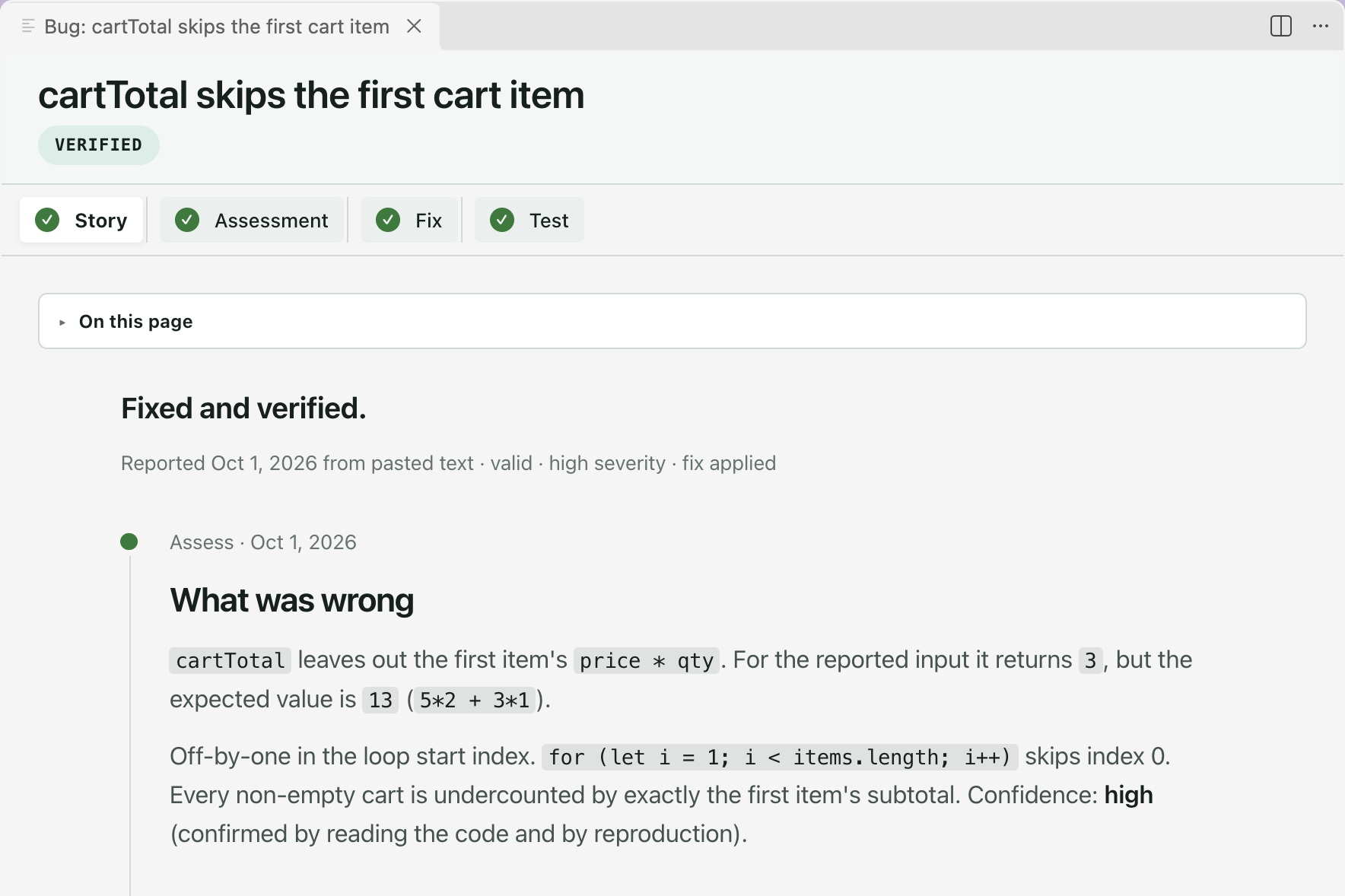
The reports as written are the tabs beside it: Assessment, Fix and Test. Clicking a report in the sidebar opens the viewer on that tab.
| The bug is | Main button | Also offered |
|---|---|---|
| Waiting for a fix | Fix bug | Test again, when a test already failed |
| Waiting for a test | Test fix | Fix again |
| Verified | Test again | |
| Closed | Assess again |
| Command | What it does | Writes |
|---|---|---|
/speckit.assess.intake |
Captures the raw idea: pasted text, a URL, a ticket or a pointer at existing code | intake.md |
/speckit.assess.research |
Gathers evidence about users, the market and prior art, including evidence against the idea | research.md |
/speckit.assess.define |
Defines the problem: users, goals, non-goals, success metrics and the cost of doing nothing | problem.md |
/speckit.assess.shape |
Shapes two or three options with their size and trade-offs, and recommends one or none | concept.md |
/speckit.assess.decide |
Scores the idea and gives the verdict | decision.md |
None of these commands changes source code. The order isn’t rigid: define can run straight from your input, without intake or research. Shape and decide both need problem.md.
In the viewer the rail lists Intake, Research, Problem, Concept and Decision, and an idea still being assessed opens on the latest stage it reached. The footer offers the next one: Research, Define the problem, Shape a concept, then Decide.
A decided idea’s Decision tab opens with the verdict and the first sentence of the rationale, then the rest of the rationale, then a Scorecard with each criterion, its rating and why.
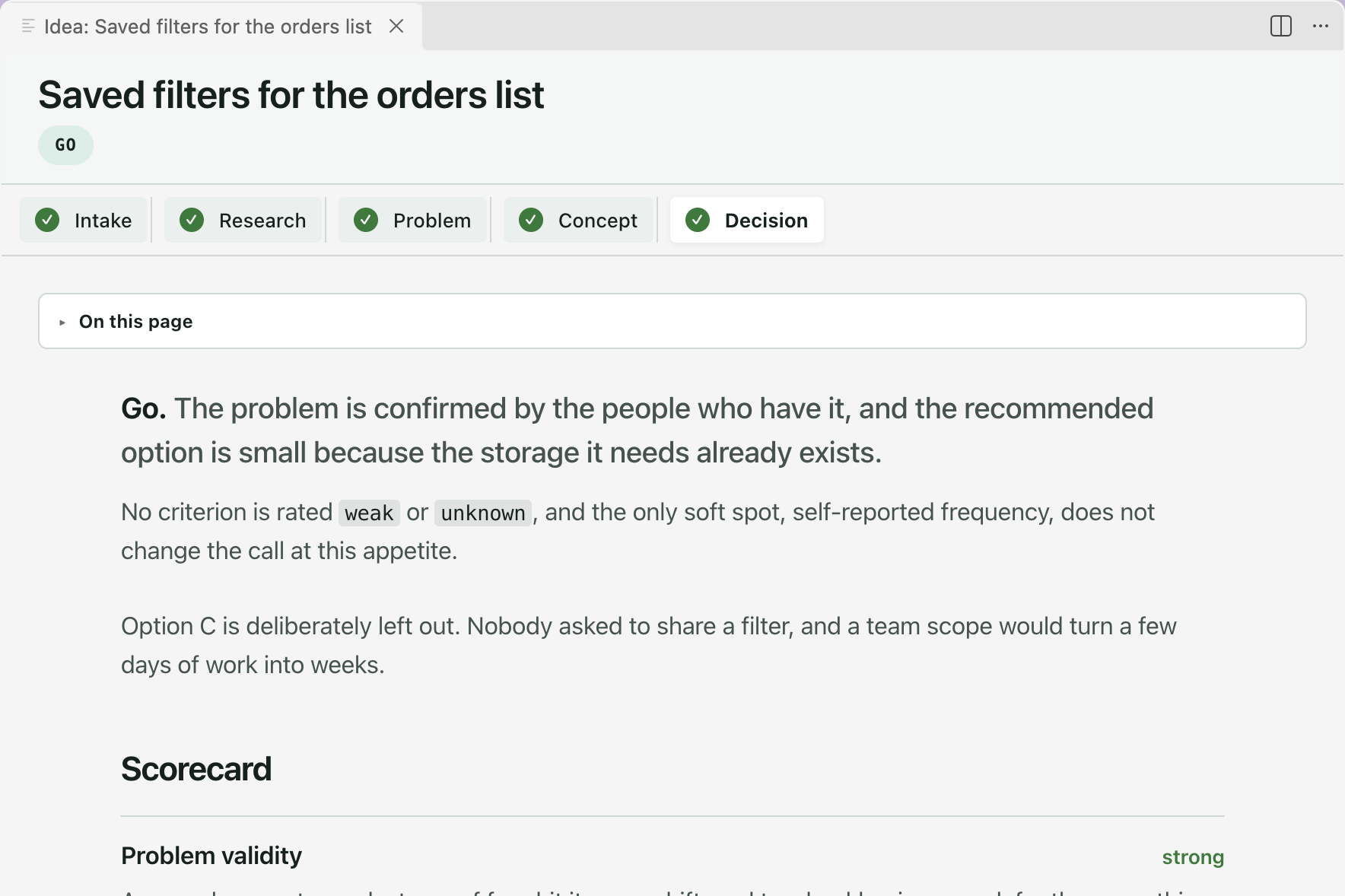
The last section of that page and the footer button both depend on the verdict.
| Verdict | Means | The page closes with | The footer offers |
|---|---|---|---|
| go | The problem is valid, the evidence is adequate and a concept is shaped | Handoff | Create spec from this idea |
| needs-clarification | Something is missing. A go without a shaped concept is downgraded to this. | What is blocking | Continue assessment |
| kill | Not worth building | Revisit trigger | Reopen from intake |
Create spec from this idea opens Create Spec with the idea’s title and rationale filled in for you to edit and send, and from there it’s a spec like any other. For a needs-clarification verdict, fill the gap in the file that has it, by editing it or asking your assistant, then have the decision revised. You don’t rerun the stage.